Just a few decades ago, it would have been unspeakable to mock someone for a public act of faith. But the severe reactions that have been inspired by Tebowing show just how uncomfortable America is with the Christian religion. Not that long ago, declarations of faith were a required part of the school day. But just a few weeks ago, the New York supreme court decided to kick out churches that rent school cafeterias on Sundays.
There’s no denying it-
American Christendom is dead.
Here’s a rough history/definition of Christendom:
Constantine begins to make Christianity a national religion with the Edict of Milan in 313.
With the fall of the Roman Empire, the structures of Roman Church try to hold Europe together.
Catholic/Protestants further the Christendom model by carving Europe, and eventually the world in to state run religious kingdom.
In the US, Christendom is more subtly spread through civic institutions use language that propagates the idea of the U.S. as Christian nation.
In short, by Christendom, I mean the idea that the Church is a ruling socio-political entity, whether by official statement or unofficial social expectations.
So, for a very long time this “Christianity” has been the litmus test of one’s American-ness. But recently, a combination of forces including everything from post-modernism to birth control to globalism has knocked Christianity from it’s position as the bedrock of America. Europe got there about 40 years earlier.
And while it spells the death of Christendom, it could very like be the best thing that could happen for the movement of Jesus in the US.
Every once and awhile I hear people complaining about the lousy christian music that they were force fed when they were kids. I smile and nod, but honestly I don’t really have any idea what they were talking about. The tribe of churches I came from were skeptical of anything from other tribes, so we shunned the books, movies and music that was being peddled by evangelicalism. We had our way of doing things, and much of our energy was spent justifying ourselves…to ourselves. In other words, we were an echo chamber.
The danger of an echo chamber is that the only voice you hear is your own. The inevitability of the political echo chamber began with cable TV and exploded with the internet. Now, you can completely cater your media experience to consist only of things that you already agree with. You’ve met people who only listen to radio, read blogs, and communicate with others who share their politics. Some days, all I want is to hear a few jokes from John Stewart, a story from Ira Glass and an episode of Doctor Who. The internet makes this customization not only possible, but normal.
I find this sad. I’m a full believer in a classic “liberal arts” education. I believe that, even if I don’t like it, having an understanding of algebra, art history and biology will make us better human beings. It breaks my heart to meet someone who doesn’t know what Tale of Two Cities or a quadratic equation is.
When it comes to theology, an echo chamber isn’t just sad, it’s dangerous. A key tennant of the Christian faith, which the western church struggles to articulate, is that everything we believe is rooted in mystery. We believe in a God-Man and a wind-like Spirit and a living lifestyle rooted in a future we have yet to see. Everything we do is rooted in mystery. This is not to say that there are not key, identifiable marks of orthodoxy. But the fact is there’s a lot we can’t know, and a lot of room to disagree.
Theological echo chambers allow you to create systematic theologies and take them to logical yet dangerous theological and practical extremes. This creates Reformers more calvinistic than Calvin, Wesleyans who become universalists and Anabaptist that withdraw to farms where no one can bother them. Practically, this creates religious arrogance. The tradition I come from (like many) is often mocked for assuming everyone else is going to hell. There might be some truth to that.
I believe in humbly seeking to hear from a multiplicity of voices. This means more than being open to hearing the arguments of the people that you disagree with. It means finding approaching life with a learning posture, assuming that even those that there are thing you can respect and emulate in everyone. And while you may come away believing what you always have, you’ll know better than ever why you believe it.
Here’s how I practice this: I attend seminary with people who have some elements of theology I disagree with. I work with a parachurch organization that trains leaders from a diversity of denominations. I listen to podcasts from Tim Keller (reformed/presbyterian) and Bruxy Cavey (anabaptist/wesleyan), Catalyst (seeker sensitive/event driven) and Iconocast (Christian anarchist). Don’t get me wrong, I have my favorites and I definitely have my opinions. But I’m better off because I learn to love and respect others.
Have you broken out of the echo chamber? Why or Why not?
Seth Rogen has made a name for himself with a series of comedies that prove to be both thoughtful and raunchy. 50/50 ups the ante, by taking on a subject that may be one of the last taboos in our society: cancer. It follows the story of Adam, played by Joseph Gordon-Levitt, who is diagnosed with spinal cancer in his late 20s.
Cancer simply serves as the catalyst for the movie’s real focus: adult relationships in the 21st century. Rogen plays the same foul-mouthed-over-sexed manchild that he plays in all of his movies. Gordon-Levitt’s character is a likable, nerdy, introverted guy who tries to “fix people.” The movies is a series of awkward moments focusing on people’s inablity to deal with the elephant in the room: impending death.
The charm of the movie is also it’s fatal flaw, it introduces a number of difficult issues, without really dealing with them. Gordon-Levitt is cheated on, yet bounces back with a sweeter girlfriend. His estranged relationship with his parents ends in him learning to pity them, rather than reconciling.
But most of all, the movie somehow fails to address it’s premise, the tragedy of mortality. Gordon-Levitt never tries to set his house in order, and barely grieves over his lost dreams. In choosing to make the movie about winning the fight against cancer, it fails to reach the depth intended. The movie reminds me of those pink “I ♥ Boobs” bracelets, that may be a great fundraiser, but also make light of a heartbreaking reality.
The movie’s shortcoming fits well into a generation that has left nothing sacred. We convince ourselves that sex is just about fun and commitment is out of fashion, yet we find ourselves alone. When we choose to run away from roots and families to hip cities (yes, I know I’m blogging this from Austin), yet we struggle to find solace in communities based on hobbies or partying. And death? Don’t worry about it. We’ll beat that eventually.
Philosopher Stanley Hauerwas talks about how, in a secular world, we have replaced spiritual communities with “churches” of sports or television or beer. These “churches” may provide distraction and relationships, yet they don’t have the ability to deal with the realities of life and death. And despite being the fact it’s probably the funniest movie ever mad about cancer, neither does 50/50.
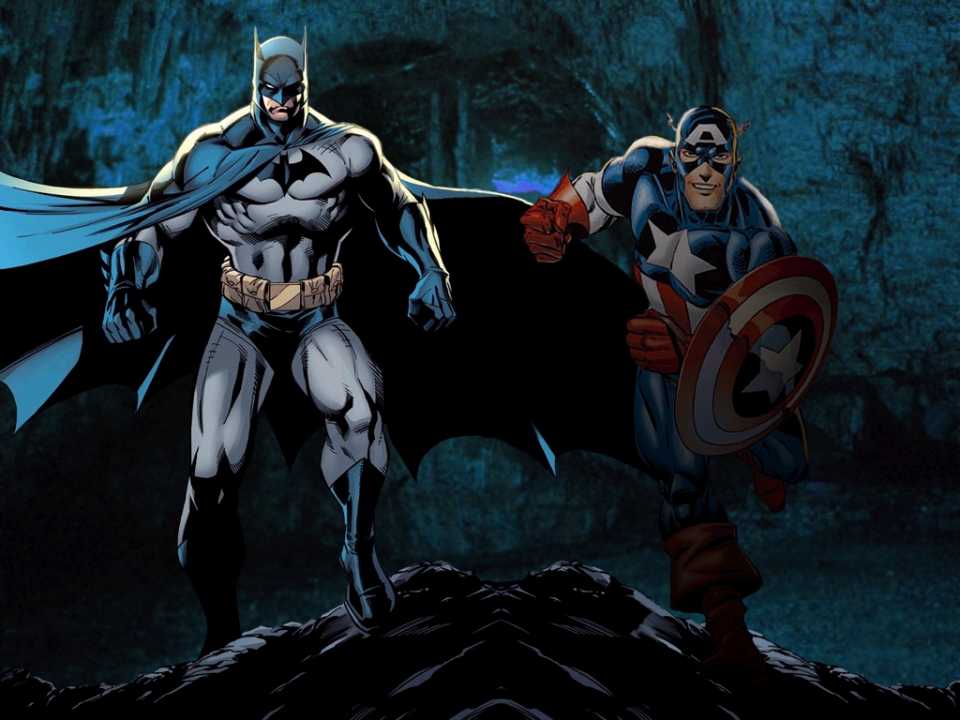
My first recollection of Batman is reruns of the Adam West camp on cable. When I was about 9 years old, my mom left me in a library, where I was totally overwhelmed whe I happened upon Frank Miller’s The Dark Knight Returns. Later that year, I followed closely as Doomsday fought Superman to the death, and Bane broke the Batman.
I waited in line to have my copies of the Reign of the Supermen signed. I was the same age as Tim Drake when he became Robin. I watched the kid with the bowl cut and sunglasses grow into Connor Kent. Over the years, there have been universe wide Infinite Crises, Justice League Identity Crises, and a new Krypton. In Gotham alone, there has been a contagion, an earthquake, a No Man’s Land, massive War Games, a dead Robin coming back with a vengeance, a new Batman, two new Batgirls, a son of Batman, and a worldwide army of Batmen.
Superman is new to Metropolis, wears jeans, can get hurt, and is a bit of a political radical. Bruce Wayne is again Batman, and Joker ismore brutal than ever. Swamp Thing is back and occassionally hangs out with Superman. The Justice League is just getting to know each other.
Then there’s some you wouldn’t expect, like the epic Stormwatch, which gives Martian Manhunter a clandestine team of Doctor Who-like universe-savers. Animal Man looks really intense. There’s Batwing, a Batman devotee protecting Africa. And there’s a lot more.
It’s hard to say goodbye to 50 years of continuity and the characters that I grew up with. My biggest disappointment is not knowing how so many stories would end. Superman has disavowed America, Tim Drake
was burnt out on being Robin, and Batman had a psychotic son to deal with. We’ll never see where those stories would end. But that was also part of the problem. Writers had to
deal with a shared fiction universe that was collaspsing under its own weight.
But you can tell that there is a new energy. The writers seem excited, and the artwork seems fresh. It’s an opportunity for DC to tell really great stories, for kids and adults. It almost makes me feel 9 years old again.