Archives For movies

Americans love Gatsby. We love the idea of a mystery man from nowhere. We want to believe, like Gatsby, that we can invent a persona to fit into our culture.

Gatsby is a story about the lengths we will go to because of shame. Gatsby’s great secret is that there is no Gatsby. An impoverished teenage boy, ashamed of his upbringing and family, invented the character of Jay Gatsby. He then spent his life lying, cheating and stealing to create Gatsby.

Churches often force people to do the same.

Continue Reading…

I blame Donald Miller for the most dangerous thing I’ve ever done in a car. During my first semester I made a weekly two hour drive from my undergrad in Searcy, Arkansas to a small seminary in Memphis.  A friend of mine had given me a copy a then unknown paperback memoir named Blue Like Jazz I only had a few chapters left and I couldn’t put it down. I held the book on my steering wheel, and did my best to split my attention between the page and the road as I read the last few pages.

Reading Blue Like Jazz for the first time was like getting a big hug and being told “no, you aren’t crazy.”  There were other people in the world struggling with genuine desire to follow Christ in spite of the hypocrisy of their church traditions.  The book helped me to verbalize my desire to help lead urban, post-Christendom churches.  It’s probably a part of why I chose to move to Austin.

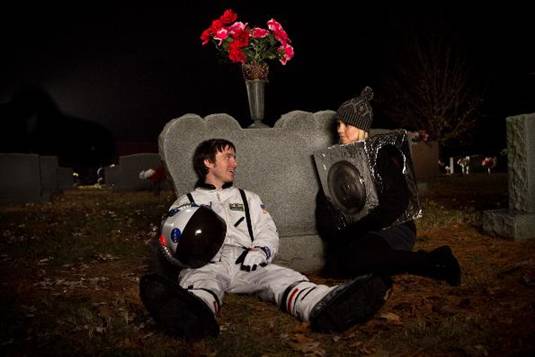
I was lucky enough to see a premier of the movie version of Blue Like Jazz during last week’s SXSW. Despite the fact that the movie suffers from the lack of budget and writing expertise that any indie films does, it captures the honesty and hopefulness that made the book a quick classic.

The film features strong performances from familiar faces, and powerfully captures the intellectualism, natural beauty and post-Christendom baggage of cities like Portland.  The fact that plot and characters could be stronger does not take away from a few powerful scenes.  The scene where the main character Don explains to his love interest Penney that her honest passion for justice “makes everyone around her feel like shit,” portrays the awkwardness many feel when they engage with Christians.  Another scene has Don cuddling, cajoling and comforting his broken hearted lesbian best friend.  And of course, there is a confession booth scene, which, despite some unavoidable cheesiness, captures the apologetically apologetic heart of the book.

Blue Like Jazz isn’t destined to win any Oscars.  It’s mainly a nod to the fans an experiment for the writers.  That being said, it should also be  required viewing for American Christians learning to live in a world where they are a minority.

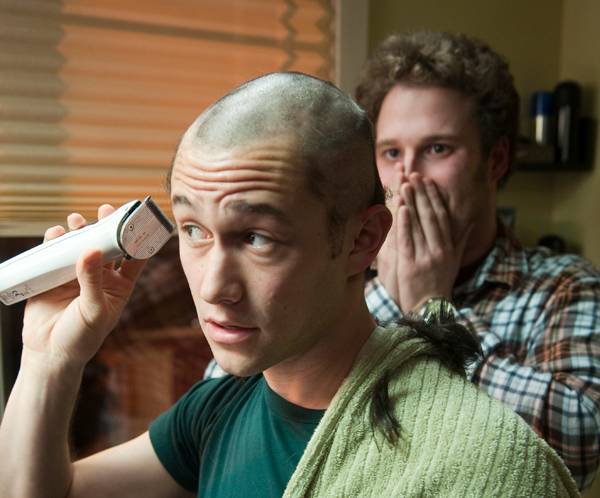
Seth Rogen has made a name for himself with a series of comedies that prove to be both thoughtful and raunchy.  50/50 ups the ante, by taking on a subject that may be one of the last taboos in our society: cancer.  It follows the story of Adam, played by Joseph Gordon-Levitt, who is diagnosed with spinal cancer in his late 20s.

Cancer simply serves as the catalyst for the movie’s real focus: adult relationships in the 21st century.  Rogen plays the same foul-mouthed-over-sexed manchild that he plays in all of his movies.  Gordon-Levitt’s character is a likable, nerdy, introverted guy who tries to “fix people.”  The movies is a series of awkward moments focusing on people’s inablity to deal with the elephant in the room: impending death.

The charm of the movie is also it’s fatal flaw, it introduces a number of difficult issues, without really dealing with them.  Gordon-Levitt is cheated on, yet bounces back with a sweeter girlfriend.  His estranged relationship with his parents ends in him learning to pity them, rather than reconciling.

But most of all, the movie somehow fails to address it’s premise, the tragedy of mortality.  Gordon-Levitt never tries to set his house in order, and barely grieves over his lost dreams.  In choosing to make the movie about winning the fight against cancer, it fails to reach the depth intended.  The movie reminds me of those pink “I ♥ Boobs” bracelets, that may be a great fundraiser, but also make light of a heartbreaking reality.

The movie’s shortcoming fits well into a generation that has left nothing sacred.  We convince ourselves that sex is just about fun and commitment is out of fashion, yet we find ourselves alone.  When we choose to run away from roots and families to hip cities (yes, I know I’m blogging this from Austin), yet we struggle to find solace in communities based on hobbies or partying.  And death?  Don’t worry about it.  We’ll beat that eventually.

Philosopher Stanley Hauerwas talks about how, in a secular world, we have replaced spiritual communities with “churches” of sports or television or beer.  These “churches” may provide distraction and relationships, yet they don’t have the ability to deal with the realities of life and death.  And despite being the fact it’s probably the funniest movie ever mad about cancer, neither does 50/50.

Warning! Spoilers and Theology Ahead! 

The funny thing about the criticism that J.K. Rowling received over the years from right wing Christian groups was the fact that they could ignore the obvious Christian undertones that characterized the books from the beginning.  A chosen child who saves his people from an evil snake?  Come on people, how did you think this book was going to end?

However it would be wrong to consider Harry an outright “Christ figure.” The truly analagous Aslan is both the creator and lord of Narnia, and the one who dies to redeem his people from their evil choices. Harry on the other hand, must kill the evil inside of him, so that he and those he loves will survive.

Harry is like any lover of Jesus: an imperfect replication of Christ.

Christ’s story is the God who died so that all might live.  What Christ accomplished in his death for the cosmos, so we accomplish in our baptism and throughout a life of growing in the way of Jesus.

Jesus put it this way:

“If any man will come after me, let him deny himself, and take up his cross, and follow me.”

So we have this image of Harry, having been murdered by Voldemort.  In between worlds, the spirit of Dumbledore points out that a little piece of Voldemort is dying.  Voldemort was inside Harry all along.  There was a part of Harry that made his life miserable.  It disfigured his forehead, gave him migrains and fits of depression, and strange abilities that scared his friends.  That piece of Harry was a piece of Voldemort buried inside of him, and it had to die so that Harry and his friends could live.

Paul, an early follower of Jesus put it this way:

“Our old self was crucified with him
so that the body ruled by sin might be done away with
that we should no longer be slaves to sin

because anyone who has died has been set free from sin.”

Harry Potter is not so much a Christ figure as a Christian Figure.  His is not a Passion Play so much as a Sanctification Story.  Christ has already died for the world.  Now we must die ourselves.

What it took Rowling tens of thousands of pages to say, Bonhoeffer put in one sentence:

“When Christ calls a man, He bids him come and die.”

Will Nolan Break the Bat?

Chris —  January 21, 2011 — Leave a comment

My first introduction to Batman was reruns of the 1960s Adam West cheeztravangza.  Then in fourth grade I wandered into a All C’s Comics to find this:A dinosaur, a jacked-up lucha libre, and the Batman in a very vulnerable position.  It was unthinkable.  I was hooked, and I’ve been reading Batman ever since.

But when I when news hit Wednesday that Ann Hathaway would be playing Selina Kyle and Tom Hardy would be playing Bane, I was more than a little scared.  The only thing worse than the last time Bane appeared in a movie was when Halle Berry put on the leather.  I really don’t understand the whole Ann Hathaway thing, and I am worried about how the over the top villain created by Kelley Jone’s demonic cover work would translate to film.

But if anyone can do it, it’s Christopher Nolan.  He finally breathed life into the Ra’s al Ghul, made the Scarecrow truly frightening, and made us all forget any Joker besides Heath Ledger.  So how can Nolan do it again, without repeating the travesty of the last superhero trilogy to end?

1.  Deal with addiction. The story of Bane is a story of obsession and the addictive power of the super steroid, venom.  Selina Kyle herself is addicted to thrill of crime.  Nolan hasn’t shied away from dark issues, and a picture of the destructive power of addiction would fit right in.

2.  Break the Bat. Knightfall told the story of the breaking of the Bat.  Bane created absolute chaos in Batman’s life, and then left him alive, but broken.  If Nolan brings in this element, he’ll show something no superhero movie has done: a mortal, vulnerable hero.

3.  Leave him broken. Nolan has promised us that this will be the end of his Batman story.  What a better way to end this definitive view of Batman than by leaving Bruce Wayne in his wheelchair.  That doesn’t mean that Bane has to win.  But it forces the audience to ask “is it worth it?”  Imagine if the story of the world’s greatest vigilante ended with a denunciation of the myth of redemptive violence.

Related Posts:

What Kind of (Bat)Man Will You Be?
Why Batman is Better than Superman